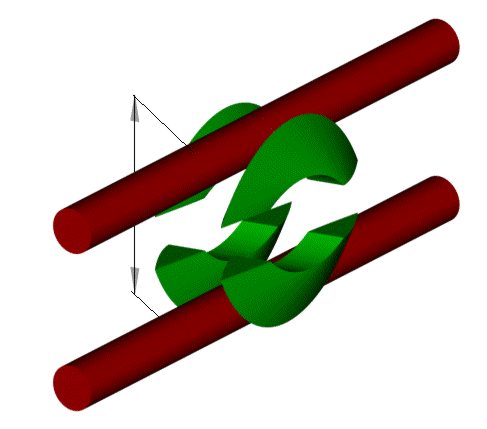
Gears, transmission error, computer models, contact pattern, bearing of contact, line of action. Completed projects.
1. Development of gear technology and theory of gearing
Zakgear develops DDS method of design, generation and computerized simulation of meshing and contact since 1978. The method was initially designed for not involute helical gears. Then it was used for determination of principal curvatures and contact ellipse for profile crowned involute helical gears. In 1986-1989 the method was used for simulation of parabolic tooth profile modification on helical and spur gears in helicopter transmissions. (Zakoldaev, B. – Lunin, S. V. 1990. "Parabolic modification of the gear tooth surface." Russian patent: 1593354)
2. DDS for determination of principal curvatures and contact ellipse for crowned helical gears
Helical gears with localized bearing contact of tooth surfaces achieved by profile crowning of tooth surfaces are investigated. The goal is to determine the dimensions and orientation of the instantaneous contact ellipse using the principle curvatures of the pinion-gear tooth surfaces. DDS computer program is applied for geometry simulation.
3. New geometry for low noise, increased strength Novikov gears.
Reduction of contact stresses is achieved by contact of convex-concave gear tooth surfaces. Crowning of gear tooth surfaces in profile and longitudinal directions are proposed. Reduction of noise and vibrations is achieved by application of a parabolic type of transmission errors. (Zakoldaev, B. – Lunin, S. V. 1990. "Parabolic modification of the gear tooth surface." Russian patent: 1593354) Methods for generation of proposed gear tooth surfaces by cutting and grinding are considered. A TCA (Tooth Contact Analysis) computer program for simulation of meshing and contact is applied. Influence of misalignment on transmission errors and shift of bearing contact is investigated. Numerical examples for illustration of the developed approaches are proposed for spiral bevel, hypoid and helical gears.
4. Conjugated profiles, line of action, avoidance of singularity and transmission error in gearing
The generation and design of cycloidal gearing that has found application in compressors are considered. The goals are: determination of profiles of the driving and the driven rotors, determination of line of action in the fix coordinate system; and avoidance of singularity of profile of the driven rotor
5. Computerized overwire (pin) or ball measurement of tooth thickness of worms,
Screws, worms, worm gears, worm face gears, hypoid, spiral bevel and helical gears. A general computerized approach has been developed for computerized ball or pin measurement of tooth thickness for gears, worms and screws.
6. Computerized design, simulation of tooth geometry and meshing of the face-gear drives.
DDS method was used for simulation of localization of bearing contact in face-gear drives with intersected and crossed axes based on application of a modified tooth surface of the pinion. Design and investigation of a new type of face gear drive with an involute worm have been developed.
7. Computer determination of singularities and envelopes of contact lines on gear tooth surfaces.
A family of tooth surfaces represented in numerical form has been considered. The contents of the project cover determination of en envelope to family of the surfaces. Valuable results for design cost reduction are achieved.
The geometry, generation and simulation of meshing and contact of low-noise spiral bevel, hypoid and high ratio hypoid gears with a localized bearing contact have been developed. The influence of misalignment on the transmission errors and the shift of the bearing contact was investigated. An approach is proposed for detection and avoidance of an edge contact caused by interference of the working part of the surface of one of the gears with the fillet surface of the mating member. The developed theory is illustrated with numerical examples and experimental tests also on not involute Novikov gears.
9. Computer simulation in gear inspection.
The authors have proposed and developed digital methods for composite gear test. The method based on DDS generated digital gear modes.
The authors have proposed a modified geometry of a face worm-gear drive (gears like Spiradrive from DAVALL Gears (UK) or gears called worm face gears) with localized bearing contact, reduced level of transmission errors and a parabolic shape of the function of transmission errors (Zakoldaev, B. – Lunin, S. V. 1990. "Parabolic modification of the gear tooth surface." Russian patent: 1593354). Computerized design of the worm-gear drive that enables to discover and avoid singularity of the generated face worm-gear surface and pointing of teeth is developed to determine the shift of bearing contact and transmission errors caused by misalignment. Numerical examples that illustrate the developed theory are provided.
The authors have proposed methods of computerized design and analysis of a wormoid-gear drive with a ground worm based on the following four considerations:
1) the theoretical thread surface of the hob is generated by a cone surface;
2) the worm surface is crowned in profile and longitudinal directions in comparison with the hob thread surface;
3) the double crowning of the worm enables to localize the bearing contact and obtain a predesigned parabolic function of transmission errors to an
assigned level (Zakoldaev, B. – Lunin, S. V. 1990. "Parabolic modification of the gear tooth surface." Russian patent: 1593354);
4) computerized design of the worm-gear drive enable to discover and avoid singularity of the generated worm face-gear surface and pointing of teeth.
The meshing and contact of the double-enveloped worm and the gear is simulated to determine the influence of misalignment on the shift of bearing contact and transmission errors. Computer program for numerical solution is developed and applied. A numerical example that illustrates the developed theory is provided.
The purpose of this project is determination of singularity of an envelope to a family of parametric surfaces. The authors propose DDS or CAD based solution to this problem based on consideration of the surface of action that is formed by the lines of tangency of the envelope and the generating surface of the tool. The proposed approach is illustrated by determination of singularity of envelopes for complex cases of surface generation. Computer programs in support of numerical solutions have been developed. The proposed developments are illustrated with the design and generation of Root's blowers.
Send comments and questions contact:
zak@zakgear.com